This space is built for young people — and anyone who wants support without judgement.
No lectures. No shame. Just straight-up help to stay smokefree, back what matters to you, and look after your body and mind.

What support means here
This page is here to support you — not to judge or pressure you.
Some people come here because they want to quit.
Some just want to understand what’s going on in their body or head.
Some aren’t sure what they want yet.
All of that is okay.
You don’t have to do everything.
You can start anywhere.
Why staying smokefree matters
Being smokefree isn’t about being perfect.
It’s about keeping your options open.
More energy for sport, training, dance, or whatever you’re into.
More money for road trips, concerts, food, and experiences — not smokes or vapes.
It’s about a clearer head, easier breathing, and feeling more in control of your choices.
Staying smokefree is one of the strongest ways to back yourself.
Better breath (no smoke or vape smell)
Whiter teeth, less staining
Clearer skin
Not coughing or wheezing during sport or movement
More money left at the end of the week
Not stressing about running out or needing a hit
Where you might be at right now
You don’t have to be ready
It’s common to have mixed feelings about smoking or vaping, or to feel unsure about what you want right now.
You might be thinking about quitting, cutting back, or just wondering how it’s affecting you.
You don’t need to decide anything here.
This page works even if you’re just looking.
The Golden Rule
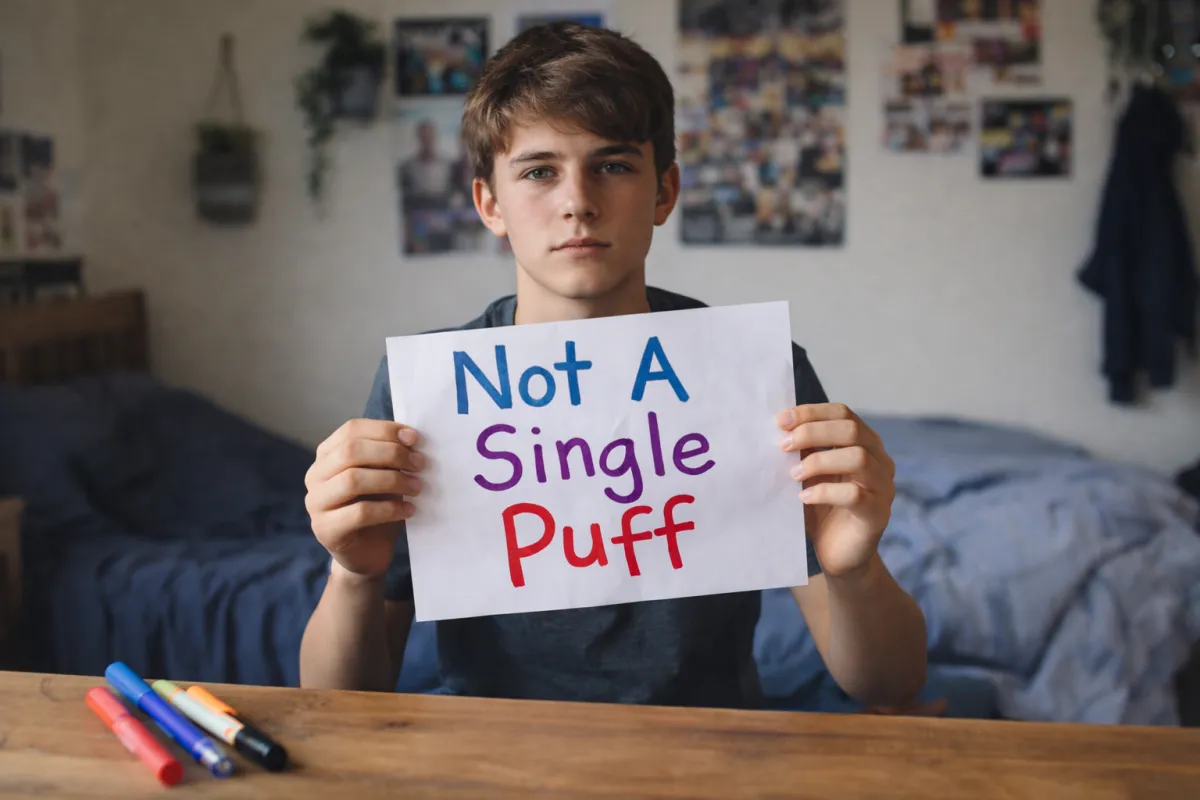
Not a Single Puff
Nicotine steals your focus and control.
One puff restarts cravings and pulls you back into the loop.
Protect yourself with this simple rule.
This is you having your own back.
Your 10 Step Game Plan
Make it personal
There’s no one size fits all. Your plan should fit your life, your crew, and your culture.
Step 1: Make a list of WHY you want to quit — and put yourself at the top.
Step 2: Add your external motivators (e.g., fitness for sport, money for a car, better skin, clearer breathing).
Step 3: Cross out the excuses that keep you stuck (e.g., “I’ll cut down”, “I’ll switch brands”).
Step 4: Write your Quit Date on the calendar.
Step 5: List your triggers — stress, certain mates, places, time of day, boredom, gaming.
Step 6: Try a smokefree solution for each trigger until you find what works.
Step 7: Tell one or two people you trust that you’re quitting.
Step 8: Throw out all your smoking or vaping gear.
Step 9: Clean your room, car, or workspace to remove smells and reminders.
Step 10. Ask a friend to be your accountability buddy — someone who has your back.
Quick wins: Lock in a weekly catch‑up with someone you trust to keep you on track.
Use whatever helps you feel okay — music, movement, journaling, or getting outside when things get tough.
Brain boost: Calms your stress system and makes cravings easier to ride out.
Choose your rewards — celebrate each smokefree week with a small treat (within your budget).
Brain boost: Releases dopamine and helps your brain lock in new habits.
Plan your check-ins — have a weekly catch‑up with a mate, cousin, or someone you trust.
Brain boost: Connection releases oxytocin, which lowers stress and strengthens change.
Learn a quick reset that works for you — like breathing out fully, then taking five slow, deep breaths.
Brain boost: Turns off fight-or-flight and brings your body back to calm.
Use what connects you to who you are — your music, your family traditions, your values, your community, or time in nature when things get tough.
Brain boost: Feeling connected to who you are strengthens motivation and focus.
Decide your rewards in advance: every smokefree week, treat yourself.
Brain boost: Celebration helps your brain remember success and repeat it.
Tools for right now
Craving? Stressed? Bored? Stuck in a vape-quit-start again cycle? Tap into what you need, right now.
Cravings

Cravings rise and fall
Cravings are a brain signal, not an emergency.
When nicotine isn’t there, your brain briefly asks for it — then the feeling peaks and fades.
That’s why cravings come in waves.
Fighting them makes it worse. Like a wave, you just ride them out.
Notice it — “This is a craving, not danger.”
Breathe slow and low — long exhale, relaxed belly.
Stay with it — most waves pass in a few minutes.
Let it fade — no action needed.
Stress

Calm the Farm
Stress flips your body into fight-or-flight mode.
Your emotional brain takes over, and your thinking brain goes off-line.
That’s not weakness or losing control, it's your brain doing its job.
Stress settles when your body starts to feel safe again.
Pause and notice — “My emotional brain is in charge right now.”
Slow the breath — longer exhale, relaxed belly.
Ground the body — feet on the floor, feel something solid.
Let it settle — your thinking brain will reconnect and put you into rest and digest mode .
Boredom

Switch it up
Boredom isn’t laziness — it’s your brain looking for stimulation.
Nicotine trains the brain to expect quick hits, so when things feel slow or flat, boredom can feel uncomfortable fast.
Boredom settles when your brain gets a different kind of input.
Change the input — music, movement, fresh air and friends.
Use your hands — draw, fidget, tidy, build something.
A different room or position can reset your focus.
Do one small task — make your bed, stack dishes, wipe a surface.
Help someone else — help out, tidy a shared space, check in on someone.
Social pressure

Your call
Social pressure causes you to want to belong.
You want to smoke or vape, when you see others doing it.
That pull is human — it’s meant to keep people safe. But sometimes it doesn't!
You can choose to be smokefree.
You don’t need to argue or explain. You are the boss of you.
Have a “go‑to line” ready.
“I’m good for now.”
Move. Step back half a metre
Take a slow breath before responding.
Stay connected without joining in.
Accept you may feel alone after taking your stand.
Speak for your future self.
Ask if anyone else wants to quit with you.
LIFE BOOSTS: Your NEW START
Willpower only works for a little while. What actually keeps you on track are a few go‑to moves that break the addiction in your brain and body. These ones genuinely help.
N — Notice what’s going on

Sometimes your body or mood gives you a heads‑up before cravings hit. Just take a quick moment to notice how you’re feeling — bored, stressed, restless, flat. You’re not judging it, you’re just checking in so you know what’s pulling at you.
E — Escape the moment

When things start pulling at you, a tiny change of scene can break the whole pattern. Step outside, switch rooms, grab a drink, move your body — anything that interrupts the moment and gives your brain a reset.
W — Water +

A cold drink, gum, mints, or something to hold can calm that “I need something” feeling fast. Keeping your hands and mouth busy gives your brain a break from the craving and helps the moment pass way easier.
S — Support people
T — Take a breath
A — Avoid hotspots

You don’t have to talk about your feelings or make it a big deal. Just being around someone who doesn’t vape, or sending a quick message to someone who gets you, can steady you fast. The right people make the hard moments way easier.

When everything feels tight or buzzy, slowing your breathing can calm your whole system fast. A few slow breaths, a stretch, or shaking out your shoulders helps your brain reset so the craving doesn’t run the show.

There are places, people, and routines that make vaping feel automatic. You don’t have to avoid them forever — just while your brain is rewiring. Skipping those pull‑zones for now makes staying quit way easier.
R — Remember why you quit
T — Treat yourself kindly

Cravings make you forget the reasons that mattered to you. Take a second to reconnect with the version of you who actually wants this — the one who’s already done the hard part. That reminder can steady you fast.

Quitting isn’t about perfection. It’s about keeping going. Talk to yourself like you would to someone you care about. Being on your own team makes every tough moment easier to get through.

Love and care for your brain
SLIPS START WITH A DRIFT
BEFORE THE PUFF
⚡Stinking Thinking Is Your Danger Zone
Most people think a slip happens in a single moment.
But it actually begins earlier — in tiny changes in thinking that feel calm and harmless. Just like drifting outside the flags at the beach.
On the surface, everything looks fine. Underneath, the current is pulling.
A slip is the moment you realise the current has you. The drift is what put you there.
“Just one puff won’t matter.”
“I’ve been quit for ages, I’m probably fine now.”
“I’m stressed — this will help for a second.”
“I can quit again tomorrow.”
“Quitting is easy. I’ll vape now and quit again next week.”
"I'll only vape while I am at the party."
“It’s only a puff, not a real relapse.”
At the beach, the water near a rip looks calm. There are no big waves, no obvious danger, nothing that screams “stay away.”
That’s why people drift into it without realising — the surface looks safe.
Slips work the same way.
They don’t begin with the puff. They begin with thought‑drift — tiny shifts in thinking that feel calm and harmless.
On the surface, everything seems fine. Underneath, something is pulling.
A slip is the moment your poor micro-choices catch you.
It’s when the nicotine trap activates.
What danger signs can you see around you?
Sometimes you can feel yourself sliding toward a slip before you even think about vaping.
It shows up in little ways — like when your body feels restless or buzzy for no clear reason, or when you suddenly feel flat or empty and can’t explain it.
Your mood might shift too. Maybe you get annoyed way faster than usual, or you feel that weird kind of boredom where you’re not bored exactly… you just want something.
Your environment can set things off as well.
Being around people who vape, walking past the places you used to vape without thinking, or even just having extra time alone in your room can nudge you closer without you noticing.
Sometimes your behaviour gives it away — checking old pockets or drawers, hovering near shops you used to buy from, or replaying old vaping moments in your head.
And then there’s the social stuff. You might start avoiding the people who help you stay on track, or drifting toward friends who vape because it feels easier than explaining yourself.
Even your self‑talk can shift. You catch yourself thinking things like, “I’m sweet, I’ve got this,” or “One puff won’t matter,” even though you know those thoughts never lead anywhere good.
All of these tiny signals add up. They’re the early signs that you’re moving closer to a slip long before anything actually happens.
So pause for a second and check in with yourself: What danger signs can you see around you right now — in your body, your mood, or your space?
Vaping FAQs
If quitting feels hard, it doesn’t mean you can’t do it.
It usually means your brain is healing, use NEW START to speed up your recovery time.
These are real questions teens ask, with straight, honest answers.
No judgement. No scare tactics. Just clarity you can actually use.
Why did vaping hook me so fast?
A lot of teens are surprised by how quickly this happens.
Most vapes use nicotine salts, not regular nicotine. Nicotine salts:
• Feel smoother
• Deliver higher doses
• Reach the brain faster
That makes the brain learn the habit quickly — often before you realise what’s happening.
You didn’t fail. The product was designed this way.
Why do I feel anxious, edgy, or not myself when I don’t vape?
That’s nicotine withdrawal, not your personality.
Nicotine boosts dopamine fast, then lets it drop. When nicotine isn’t there, your brain feels unsettled for a while. This can show up as anxiety, irritability, low mood, or feeling off.
It’s uncomfortable — but temporary. As your brain rebalances, this eases.
Why is quitting easy for some people but really hard for me?
Because dependence levels differ.
Quitting is often harder if you:
• Use high-strength disposables
• Vape soon after waking
• Use nicotine for stress, focus, or mood
Struggling doesn’t mean you’re weak.
It usually means your brain learned the habit more strongly — and brains can relearn.
What’s actually normal when you stop (cravings, sleep, focus)?
Cravings usually come in waves — they rise, peak, and fall.
Most last 5–15 minutes, even if they feel longer.
Sleep and focus can be off at first because nicotine hijacks these systems.
Your brain gradually relearns balance — usually within weeks.
Is cold turkey the only way, or is it okay to get help?
Cold turkey works for some people, especially with lower dependence. For many others, it doesn’t — and that’s normal.
Some teens find short-term support helpful, like:
• Text or app support
• Coaching
• Step-down plans
Needing help isn’t cheating.
It’s strategy — and the goal is still no nicotine.
Why do I feel embarrassed about vaping — and will quitting change who I am?
Nicotine affects identity as well as chemistry.
Many teens say things like:
• “I don’t recognise myself”
• “I hate needing it”
That feeling is common — and temporary.
Quitting doesn’t take away who you are.
It helps you feel like yourself again.
Is vaping actually safer than smoking, or not really?
Is vaping actually safer than smoking, or not really?
Vaping is less harmful than smoking, but it isn’t harmless.
With regular use, vaping can:
• Inflame blood vessels
• Affect breathing and circulation
• Change how the brain works
“Safer than smoking” doesn’t mean “safe.”
Is synthetic nicotine safer… and am I the only one thinking about quitting?
No — synthetic nicotine isn’t safer.
Your brain doesn’t know the difference.
Whether nicotine comes from tobacco or a lab, it still hooks the brain and keeps cravings going. Some vapes deliver nicotine faster and in higher doses, which can make quitting feel harder — not because of weakness, but biology.
And no — you’re not alone.
Most teens who vape say they want to quit, and many are trying.
If you’re even thinking about quitting, you’re already in good company.
Do my parents have to know I’m here or that I’m thinking about quitting?
No. This page is here for you to read, think, and come back to anytime.
There’s no sign-in and no reporting.
If you ever choose to talk to a parent or trusted adult, that’s up to you — and only when you’re ready.
That’s it.
Nothing more needed.
If you ever have a question, feel unsure about something, or just want to talk it through, you’re welcome to email me anytime at [email protected]. I’m here to help you make sense of things in a way that feels safe and judgment‑free.
You don’t have to figure this out alone
You don’t have to do this alone
Reaching out is strength, not weakness. There are people who get it and want to see you win.
Free youth helplines – text or call for confidential support.
Local hauora or Māori health services – culturally safe awhi.
School / Uni support – counsellors, nurses, kaimahi Māori.
Talk to your own whānau (family) – you might inspire someone else too.
Quick support options
Text services: Check your local smokefree or youth text line – save it in your phone now so it’s there when you need it.
Online chats: Many hauora and youth services have webchat or DMs – perfect if you don’t feel like talking out loud.
In-person: If it feels safe, ask your GP, nurse, or school health team about smokefree support and nicotine replacement options.
Wherever you’re at, you deserve to feel proud of the effort you’re making.


©️QuitStrong 2025. All rights reserved.